
Mechatronics engineering student focused on data-driven design. Seeking full-time roles in mechanical/mechatronics engineering.
Luis Daniel
Weiss Quiroz
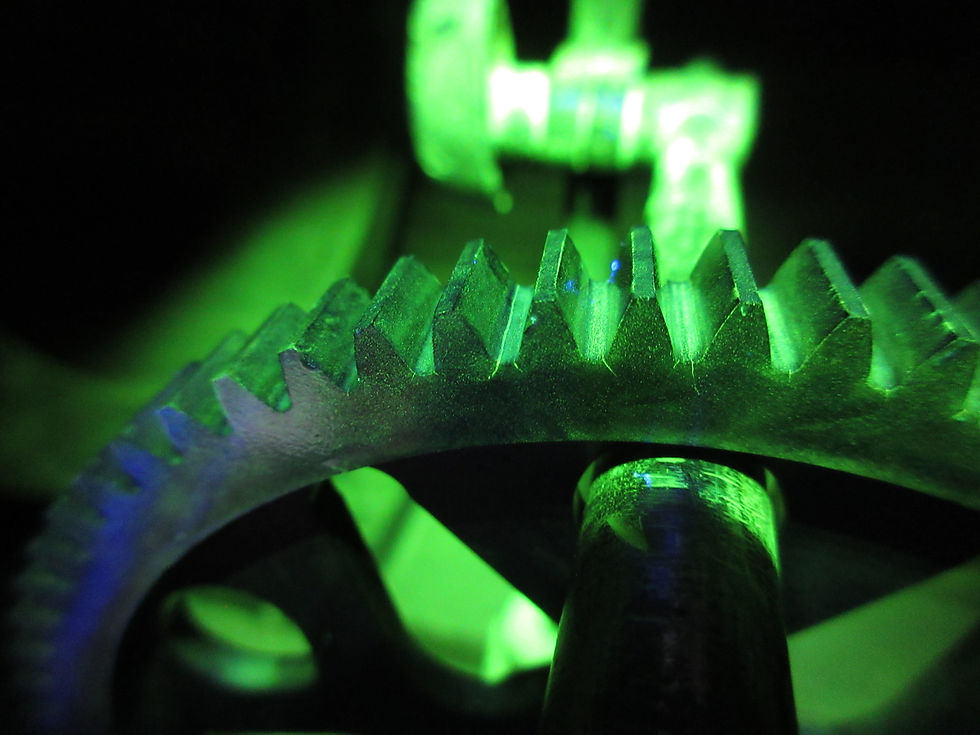
Magnetic particle inspection of a broken gear from a 2024 gear failure.
Featured Engineering Challenges
Drivetrain Ratio Optimization
- Situation: 4.2s 100ft acceleration and 32mph top speed - below competitive targets
- Task: Achieve sub-4.00s 100ft acceleration and 40mph top speed without sacrificing torque output
- Action:
- Developed a MATLAB model for vehicle performance
- Used data to validate the model
- Determined CVT & gearbox ratios for the new 2025 drivetrain
- Result: [2025 vehicle, summer]:
- 4.2s 100 ft acceleration - acceleration goal not met due to untuned CVTs
- 41mph - speed goal met
- 260ft-lb max output torque - insufficient torque output
- Action:
- Designed & implemented a CVT data acquisition system to make data-driven tuning decisions; improving the CVT tuning process
- Result: [2025 vehicle, fall]:
- 4.05s 100ft acceleration - 0.15s improvement - does not meet goal
- Vehicle placed 3rd overall in Maryland competition out of 100 teams
- Action:
- Found gaps in the model assumptions such as constant CVT efficiency & infinite CVT shift rate
- Updated model with new parameters
- Result: [2026 vehicle]:
- Currently at 4.01s 100ft acceleration- In process of tuning CVTs
- Expected 41mph top speed
- Expected 310 ft-lbs output torque
These process-driven case studies highlight the intersection of simulation, validation, and iteration.
Rear Gearbox Design - RCA & Fatigue Optimized Design
- Situation: 2023 input shaft failure mid-season; design also over-built and above weight target
- Task: Design a lighter, reliable two-stage rear gearbox
- Action:
- KISSsoft for gear design & fatigue analysis
- ANSYS & SolidWorks FEA on all components
- Result: [2024 gearbox]:
- Reduced weight by 1.1 lbs - achieved goal
- 10hr fatigue life - fell short because rainflow loading was oversimplified
- Action:
- Conducted wheel force transducer (WFT) testing on the vehicle to determine load cases
- Created a new comprehensive rainflow using race videos from 6 different competitions and results from WFT testing.
- Re-conducted analysis and created a new design
- Result: [2025 gearbox]:
- Further reduced weight by 1.3 lbs - achieved goal
- 18+hr fatigue life - achieved goal
Rear Gearbox Mounting Redesign
- Situation: Traditional rear gearbox mounting failed to meet the minimum FOS of 1.1 under full-assembly simulation
- Task: Collaborate across 2WD, 4WD, integration, brakes, and frame teams to find a compliant solution that met vehicle goals
- Action:
- Developed three countermeasures
- Ran full-assembly simulations with all interacting subsystems for all countermeasures
- Determined best countermeasure to implement
- Result:
- Min FOS of 1.12
- Reduced weight by 0.7lbs
- Cut part count by 5
- Maintained serviceability for all subsystems.
2min Project Walkthrough
A quick walkthrough of how I approached one of my most impactful engineering challenges, bridging simulation and real-world results.
Additional Projects
Supporting technical projects showcasing specialized engineering skills, cross-functional collaboration, and practical design iteration.


Used Toyota problem-solving methods to develop assembly line countermeasures.
Compared gear design software capabilities and re-designed gear fatigue life test rig.
Designed & tested the rear gearbox for RIT's BAJA SAE team following the full design cycle.
Focus: Genchi Genbutsu & Engineering Design
Focus: Gear Design Software
Focus: DFM, Testing & Validation, Analysis Correlation


.png)
Conducted FEAs to accurately determine the life of the brake hub & correlated the results to testing.
Won 1st place by creating and defending an accurate vehicle cost eBOM with manufacturing justifications.
Used generative design to generate the structure of a ping pong ball launcher, ensuring manufacturability.
Focus: ANSYS FEA, Analysis Correlation
Focus: Cost Analysis
Focus: Generative Design Methodology